
Crafting
Building and crafting are two halves of one way of making things. Press O (or open the Craft tab in the build menu) and choose what to make.
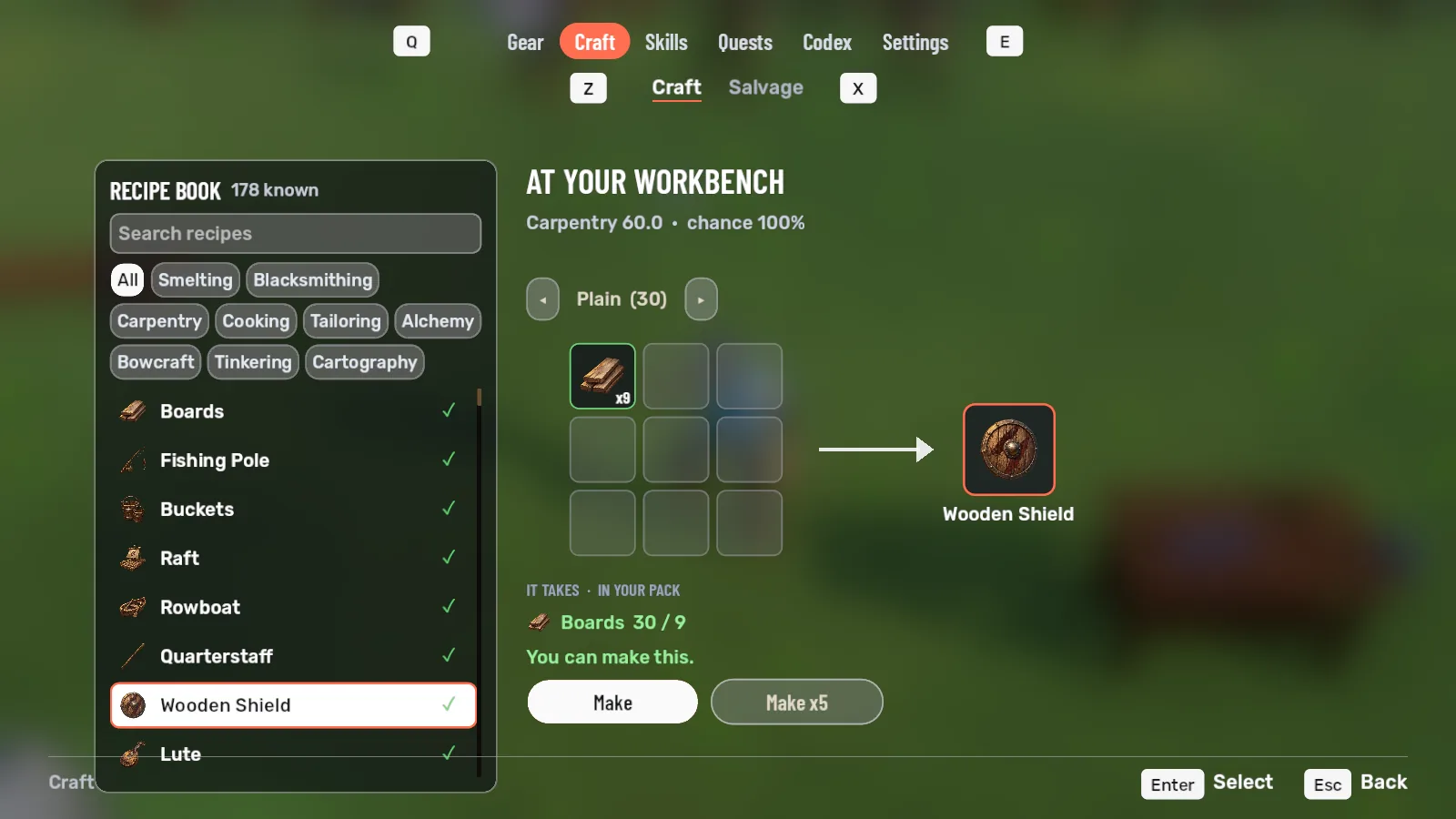
The ten crafts
Carpentry, Blacksmithing, Tailoring, Tinkering, Cooking, Alchemy, Bowcraft, Cartography, Mining, and Smelting, which melts ore into ingots at a forge, and sand dug on a shore into glass and then bottles. Between them they hold more than 170 recipes, from a wooden knife to a steel blade to a bowl of stew.
Where you stand
What you can make depends on where you are. The top of the Craft tab says so: By hand, At your workbench, At your forge, or, in red, what you need to stand by.
- By hand, anywhere: a small 2 by 2 grid, for first tools and simple things.
- At a workbench or an anvil: a 3 by 3 grid. Carpentry, bowcraft, tinkering and tailoring are made at a workbench.
- At a forge: the furnace, with what goes in over the flame and what comes out.
- At a fire: the cooking pot.
The workbench is a heavy table with a saw, a mallet and a vice. It costs 6 logs and 4 sticks, and you learn to build it once you carry logs or boards.
How to make something
- Choose a craft from the chips along the top of the recipe book, or type to search. What you can make now comes first, with a tick; the rest say what stops them, such as “Needs a workbench nearby”, “Skill too low” or “Short of things”.
- Choose a recipe. The right side shows your skill and chance, and the grid, with each slot edged green or red by what you carry.
- For things made of metal, wood or leather, choose the material with the arrows beside it.
- Choose the recipe again, or press Make (or Make ×5; Smelt at a forge, Cook at a fire). On the controller, move to it and press ✕.
Each try takes a moment, with the craft's own motion and sound. Walk away or start a fight to stop.
Skill, chance and failure
- Every recipe has a skill range. Below it you can't make the thing; at the bottom of it you succeed half the time; at the top, every time.
- A failed try loses half the ingredients.
- A harder material asks for more skill and makes a better thing.
- Every try trains the skill, more for harder recipes.
Exceptional work
Once you are past the middle of a recipe's range, weapons and armour can come out exceptional: worth more, a little stronger, and able to carry magic bonuses. The better your skill, the more often it happens.
Tools and stations
Most crafts need a tool in your backpack: a saw for carpentry, a smith's hammer for blacksmithing, a sewing kit for tailoring, tinker's tools, or a mortar and pestle for alchemy. Some work needs a station close by:
| Station | Used for |
|---|---|
| A workbench | Carpentry, bowcraft, tinkering and tailoring |
| A fire (a campfire or a hearth) | Cooking and charcoal |
| A forge | Smelting ore, making bronze and steel |
| An anvil, with a forge | Metal tools, weapons and armour |
| A spinning wheel | Fibre, flax or wool into thread or yarn |
| A loom | Thread into cloth |
You can build all of these yourself in build mode, under Workshops. A forge's bellows, driven by a lever or a clock, can even smelt ore for you; see Machines.
Workshops
Build add-ons within three metres of a station and it becomes a workshop: a quench tub and a coal bin by a forge, a tool rack by an anvil, a cooking spit and a herb rack by a fire. Each kind counts once, up to three, and each one adds 5 to your skill there and makes the work quicker. On your own village’s land the station gets a little better again. Its level shows in its name, up to Forge IV.
On your village’s land, the chests feed the benches too. The craft window counts what is in them as well as what you carry, and takes only what you are short of from the chests.
Alloys
- Bronze: three copper ingots and one tin ingot make four bronze.
- Steel: two iron ingots and one coal make two steel.
Made in your people's colours
What you craft takes the look of the land you make it in. A hatchet made in Norse land is "a Norse hatchet", in the Norse colour. It chops like any other hatchet. See styles.